

Article
Best practices for storing AM powders
Additive manufacturing (AM) begins with the powder. These finely engineered materials must maintain their chemical purity, particle structure, and flow behaviour to ensure high-quality, repeatable prints. Poor storage compromises performance, increases the risk of print failure, and introduces safety concerns. To meet the demands of precision production, careful storage of AM powders is required to preserve material quality and ensure consistent printing outcomes.
Environmental Control
AM powders are reactive to ambient moisture and oxygen, which can quickly alter their chemical and physical behaviour. Even short-term exposure can result in surface oxidation and changes in particle cohesion. Stable environmental conditions are crucial for preserving AM powder performance throughout its usable life.
Best practices:
-
Keep humidity below 5% and temperature consistently moderate in storage areas.
-
Place reactive materials like titanium in climate-controlled enclosures or dry rooms.
-
Use real-time sensors to track environmental fluctuations and ensure long-term stability.
Use of Inert, Airtight Containers
The interaction between metal AM powders and ambient air can quickly compromise quality. Airtight containers with inert gas backfilling protect against oxidation and unwanted chemical reactions. Selecting the right container materials also helps avoid static build-up and physical contamination.
Best practices:
-
Store AM powders in airtight containers made from stainless steel or static-dissipative plastic.
-
Purge containers with inert gases like argon or nitrogen after each use.
-
Check sealing mechanisms regularly and replace damaged or worn gaskets to prevent leaks.
Labelling and Traceability
Traceability ensures manufacturers can track AM powder from receipt through every print cycle. Clear labelling reduces the risk of misidentification and supports regulatory compliance. Proper documentation also enables better control over AM powder reuse and material qualification.
Best practices:
-
Include the material name, alloy type, batch number, supplier, date received, and reuse cycle on every container.
-
Utilise digital tracking systems that log movements, test results, and inventory levels.
-
Integrate traceability data into quality assurance and regulatory documentation workflows.
Segregation of Materials
Contaminating one AM powder with another can lead to unpredictable alloy compositions and failed builds. This is especially risky when working with reactive or high-performance materials. Preventing cross-contact starts with strict spatial and procedural separation.
Best practices:
-
Contain each alloy in a physically separate, clearly marked zone within the facility.
-
Dedicate tools, sieves, and containers to individual material types.
-
Apply colour-coded containers or barcode systems to visually and digitally distinguish between AM powders.
Routine Quality Testing
As AM powders are reused or stored for long periods, their physical and chemical properties can shift. Regular testing helps detect degradation before it affects production. Alongside this, testing supports consistent part performance across build cycles.
Best practices:
-
Test for flowability, particle size distribution, apparent and tap density, and oxygen or nitrogen levels.
-
Establish quality thresholds that determine if powder is suitable for reuse or blending.
-
Document all test results and use them to update inventory status and usage logs.
Dedicated Storage Zones
AM powders should not share space with general production activities, where contamination and physical disruption are common. A dedicated storage area helps maintain a controlled environment and supports procedural consistency. Moreover, it ensures better compliance with safety regulations.
Best practices:
-
Create a designated area used solely for powder storage, away from heat, vibration, and machining.
-
Install anti-static flooring, clean air filtration, and environmental controls.
-
Restrict access to trained personnel to limit traffic and handling errors.
Safety and Hazard Mitigation
Fine metal AM powders can pose fire or explosion risks under the right conditions. Their high surface area and reactivity demand a strict safety infrastructure. Preventive measures protect staff and maintain powder viability.
Best practices:
-
Ground all containers and storage furniture to prevent static discharge.
-
Equip the facility with Class D fire extinguishers and explosion-rated lighting and HVAC systems.
-
Provide full PPE to personnel, including gloves, antistatic suits, and respirators when necessary.
SOP Development and Compliance
A standard operating procedure (SOP) is a documented method for performing specific tasks consistently and safely. SOPs help eliminate variability in how AM powders are handled and stored. Following these procedures ensures compliance and operational efficiency.
Best practices:
-
Develop detailed SOPs for powder loading, sealing, transferring, storage, and emergency handling.
-
Train all employees on these procedures and provide refresher sessions.
-
Conduct audits to confirm compliance and adjust SOPs in response to new materials or technologies.
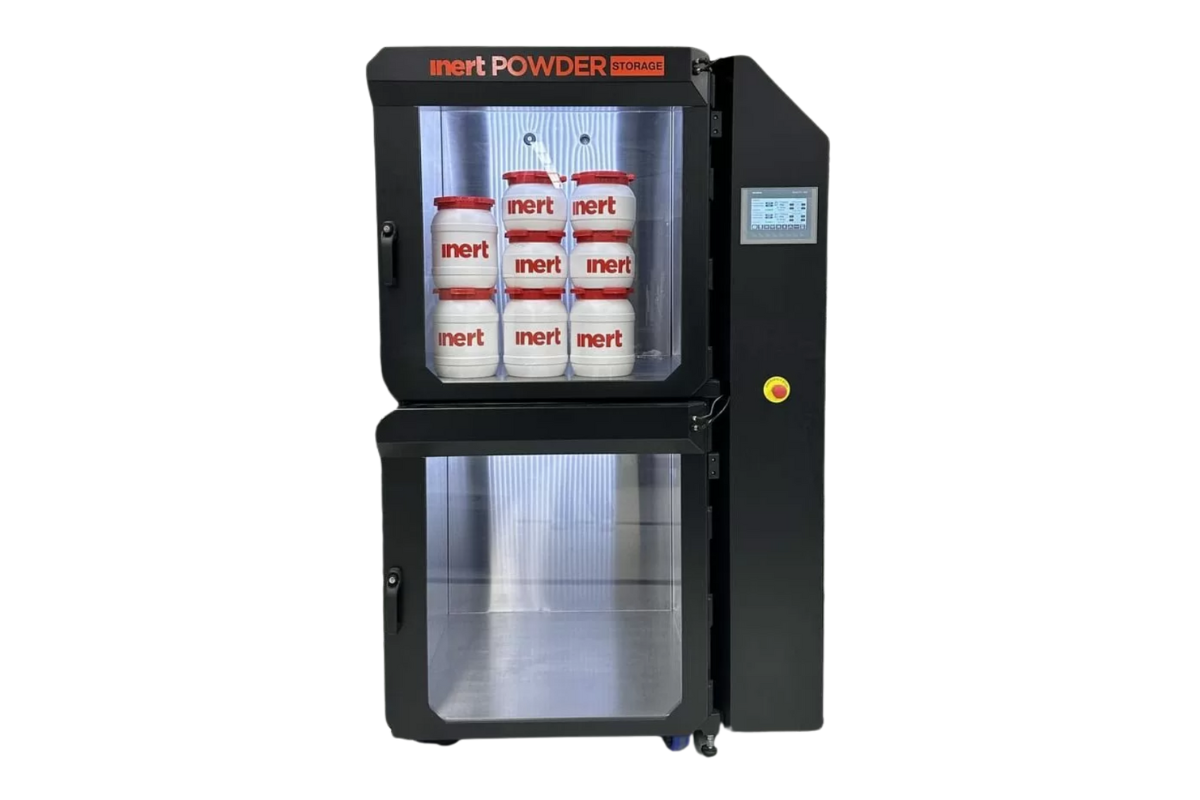
PowderStorage from CN Tech
Implementing best practices becomes far more efficient with the right infrastructure. Our PowderStorage is designed specifically for additive manufacturing environments. It provides a fully inert, monitored enclosure that helps preserve up to 5,000 pounds of metallic powder in ideal conditions. With precise control over internal oxygen and moisture levels, secure access, and rugged stainless-steel construction, PowderStorage supports long-term quality and enhances safety.
Key features include:
-
The real-time monitoring of oxygen and humidity levels via a touchscreen interface.
-
An inflatable gasket sealing system that maintains an airtight environment while minimising gas use.
-
Lockable access controls that restrict entry to trained personnel only.
This system aligns with best practices by offering an all-in-one solution to protect, manage, and maintain AM powders.
Optimising AM Results with Smarter Powder Storage
Reliable additive manufacturing begins with how powders are stored. Proper handling not only preserves material quality but also safeguards operators and ensures compliance with industry standards. Through following structured best practices and integrating proven tools like PowderStorage, manufacturers can improve consistency, reduce waste, and protect the value of every powder batch from day one.